A sprint discovery project based around the concept of global sentiment analysis.
The project was inspired by the rise of the Situation Monitor — a tongue-in-cheek UI/UX dashboard schema based around the meme of monitoring the situation.
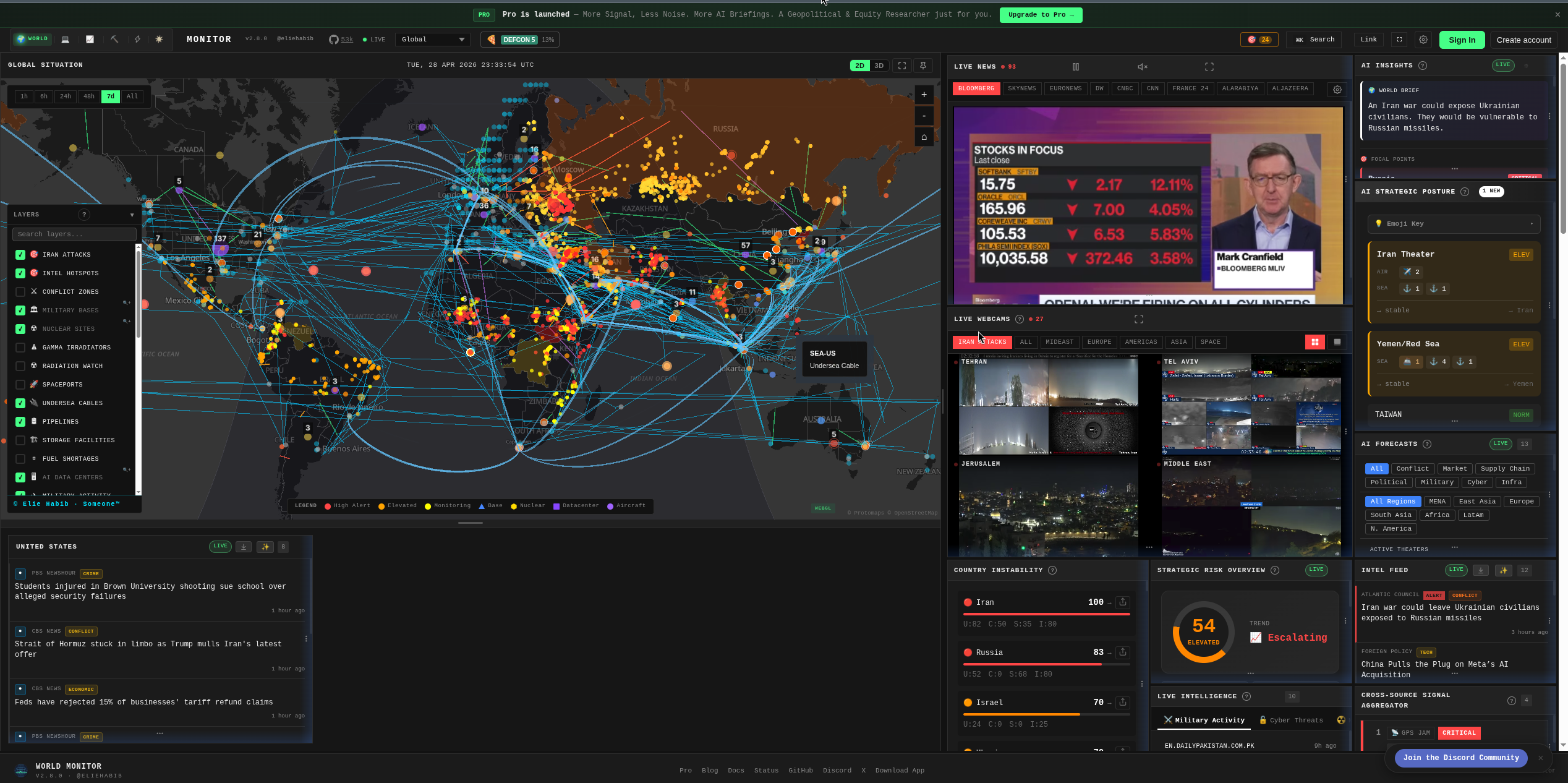
There are several versions of these dashboards accessible online, both paid and free. They are designed to maximize signal flow for world events across news, markets, and supply chain indices. They include as many viable metrics as possible, as well as several comedic/interpretive signals such as the Pentagon Pizza Index.
The question raised by these UI experiments is: what is the line between hard analysis and emotional interpretation in a metric as expansive as global sentiment? In particular, how can global sentiment indices be used as modulation values for poetic computation?
It is well known that there is a horseshoe relationship between the most acute data-driven technical analysis used to predict markets and highly speculative, vibe-based indicators that border on (or directly pull from) astrology. Other metrics are so vast in their aggregation of information that their compression into a single metric is somewhat justified, such as the GDELT Project (Global Database of Events, Language, and Tone).
All of these metrics share a common trait: they are ambient by design. Their simplification into a single value score is used as an at-a-glance vibe check to support sentiment analysis, often on the viability of a financial risk.
In an increasingly agentic world, these metrics hold more sway than previously thought, because automated processes are often making decisions via benchmarks. An AI agent will suggest a model or piece of software because it has the highest bench score or the most stars on Github. The same is true for models that look to these indicators automatically as vectors for decision making.
The dance between human and machine is one where humans need to preserve our sense of intuition, our most valuable asset in relation to computation, in order to keep pace with automation. What other senses do we have access to in our wetware to aid in this intuitive multitasking?
The Situation Synth was born out of this question, and has a simple but effective premise. If global sentiment analysis is ultimately expressed as a single floating point value, that value can be used to drive other types of sensory indicator. In this case, a multichannel audio composition.
An audio signal is just as intuitive as a visual indicator, like a stock heatmap or a Fear & Greed Index meter. It can also be beautiful, and in a world where software is becoming more sensorial, this is a valuable characteristic.
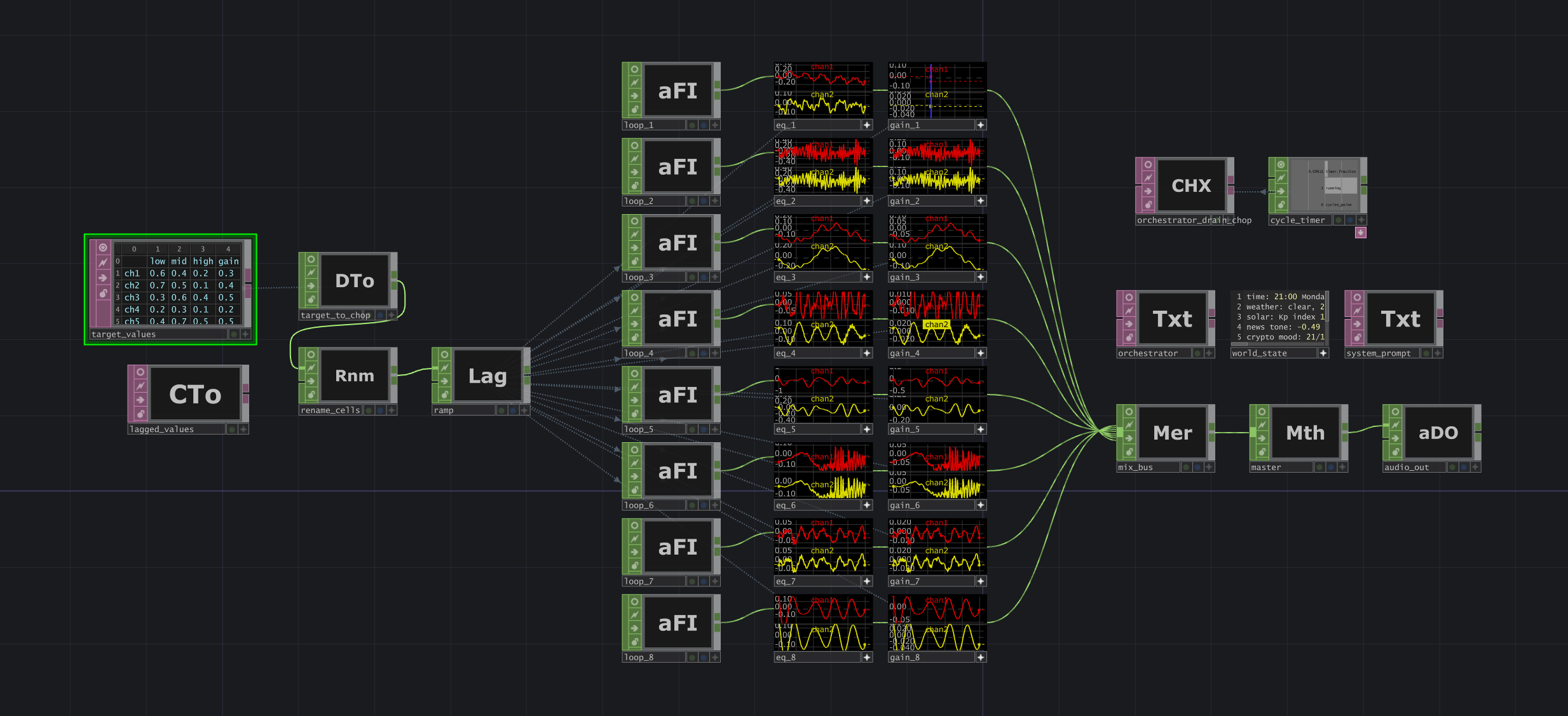
The design of the synth is simple. Python to pull the APIs of various sentiment analysis indicators once every minute as clean float values between 0 and 1, and TouchDesigner to inject these values into a table, create smooth ramps between changes, and use those ramped values to drive the gain, filter and equalization of 8 looping channels of ambience.
The eight channels are grouped into three tiers that each read from a different slice of the incoming world state. Think of the mix as a stack: a geological foundation at the bottom, a human/news body in the middle, and a financial/sentiment shimmer on top.
Channels 1–2: FOUNDATION DRONE (geo / natural / terrestrial). Driven by the planetary signals — time of day, solar/geomagnetic activity, weather, seismic events, space-weather, any biological or environmental rhythms. Slow, low, structural. This is the ground the piece stands on.
Channels 3–5: TEXTURED MIDTONES (world news sentiment). Driven by the news-tone and collective-attention signals — GDELT tone, Wikipedia pulse, headlines. The social body of the piece. More detail, more movement than the foundation. These react to what humanity is paying attention to, and how it feels about it.
Channels 6–8: TOP SHIMMER (market / financial sentiment). Driven by the market signals — VIX volatility, CNN Fear & Greed, crypto Fear & Greed. The anxious, flickering top layer. Fear, greed, and volatility live here. Fastest-moving emotional register.
Maybe will become available in the future as a live audio feed.